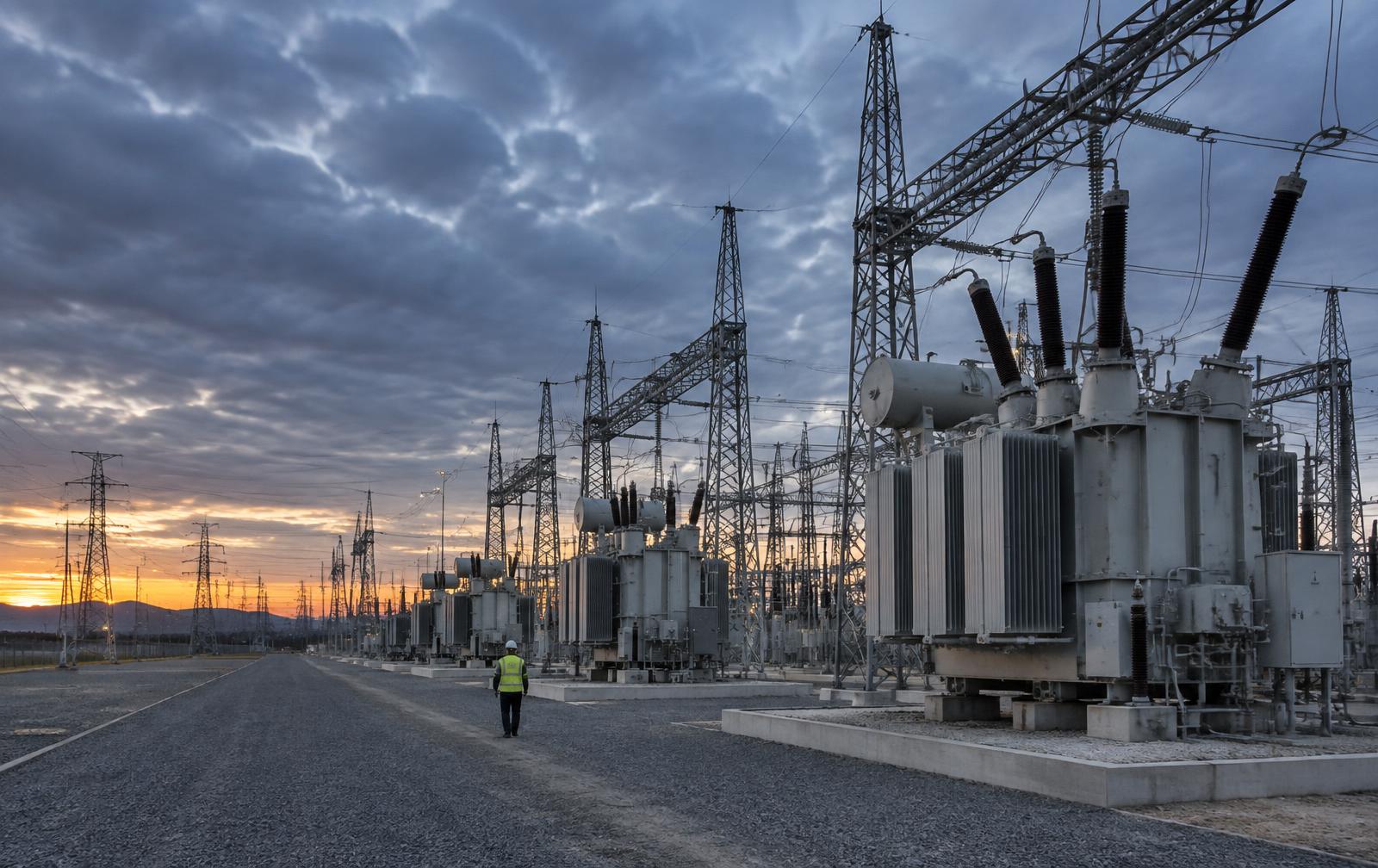
AI's buildout requires more electricity, and getting that power to servers requires grid equipment and thermal management. Those suppliers may benefit—but demand, profits, and stock returns are three different things. This briefing maps the opportunity and the reasons it might disappoint.
The digital economy has a physical bill.
The International Energy Agency estimated global data-centre electricity use at roughly 460 TWh in 2024 and projected it to more than double to about 945 TWh by 2030 in its base case. That is a forecast, not a guaranteed outcome; efficiency gains and AI adoption could move it in either direction.[1][2]
Every new compute campus needs far more than chips. It needs a reliable grid connection, switchgear to distribute power, transformers to change voltage, backup power, and cooling to keep equipment within operating limits. The investment question is not simply “will AI grow?” It is “which scarce, necessary inputs can suppliers deliver profitably?”
The grid is not a software update.
New data-center demand meets an electricity system built over decades. Grid connection queues, siting, labor, and equipment procurement all move on different clocks than software releases. The U.S. Department of Energy's 2022 supply-chain report described distribution-transformer lead times rising from a pre-2022 range of three to six months to one to two years, while large power transformers often took more than two years. These historical figures describe that report's period, not a live quote for today's orders.[3]
A later DOE report to Congress identifies long replacement lead times for large power transformers as a resilience issue.[4] More demand can support pricing and backlog for suppliers, but a backlog only becomes an investment payoff if companies execute, protect margins, and convert orders into cash.
Three ways to meet the load.
These are research subjects, not buy recommendations. The financial references below use FY2024 filings; check the newest filings and current prices before making a decision.
Eaton
POWER DISTRIBUTIONThe business. Eaton sells electrical equipment and power-management products across its Electrical Americas and Electrical Global segments, alongside aerospace and vehicle businesses. Its electrical portfolio gives it exposure to grid modernization and data-center power distribution, but AI is not its entire revenue base.[5]
Revenue exposure. Look at reported Electrical segment sales and orders in the 10-K; do not treat all Eaton revenue as “AI revenue.” Valuation check. Compare a current enterprise-value or earnings multiple against electrical segment growth, margins, free cash flow, and the aerospace/vehicle mix. A premium only works if execution sustains it. Risks. Industrial cycles, project delays, input costs, and valuation compression.
Vertiv
POWER & COOLINGThe business. Vertiv supplies critical digital infrastructure including power management and thermal systems for data centers. This is a more direct data-center infrastructure lens than a diversified industrial conglomerate.[6]
Revenue exposure. Read the company's regional sales and product/service disclosures rather than assuming every dollar is AI-specific. Valuation check. Compare the current price with sustainable margins, backlog conversion, service mix, and cash flow—not just headline order growth. Risks. Concentrated exposure to data-center capital spending, competition, supply-chain execution, and high expectations already priced into shares.
Schneider Electric
ENERGY MANAGEMENTThe business. Schneider Electric makes energy-management and industrial-automation products, including power distribution and data-center equipment. Its Energy Management segment is relevant to the thesis; Industrial Automation and other demand drivers also shape results.[7]
Revenue exposure. Use segment figures in its universal registration document; “energy management” is broader than AI. Valuation check. Weigh segment growth and cash generation against the current market price and a broader industrial peer set. Risks. Slower electrification, regional demand, currency exposure, and execution on large projects.
What if the bottleneck disappears?
The strongest case against this thesis is that AI's electricity demand grows more slowly than expected—or becomes easier to serve. More efficient chips and models, slower spending by large customers, faster grid upgrades, or excess new capacity could undercut equipment demand. Even if the grid investment cycle persists, higher competition and capacity expansion could push prices and margins down.
Watch utilization. Large AI campuses delay or cancel projects; data-center power demand diverges materially below IEA scenarios.
Watch the order book. Orders and backlog stop converting into revenue and free cash flow across multiple reporting periods.
Watch margins. New supply, cost inflation, or aggressive bidding turns volume growth into weaker profitability.
Watch expectations. Share prices assume years of flawless growth while reported fundamentals fail to keep pace.
What could $10–$50 a month look like?
You do not need the price of a full share to learn from this theme. Some U.S. brokerages allow dollar-based fractional purchases of eligible stocks and ETFs for as little as $1 or $5; eligibility varies by provider and security.[8][9] A thematic infrastructure or utilities ETF may spread single-company risk, but can still be concentrated and charge an expense ratio. Check its holdings and fees before buying.
A practical framework: start with an emergency buffer and high-interest debt priorities, choose an amount you can repeat without strain, and consider a diversified core before putting a small portion toward a theme. $10–$50 is an illustrative monthly budget, not a prescribed allocation. Fractional shares can have different transfer and voting rules; verify them with your broker.[9]
Compare beginner-friendly platformsFollow the evidence.
Source dates matter. Company references use FY2024 documents; electricity forecasts and transformer lead times are from the reports named below. Revisit newer reports before acting.
- 01IEA, Energy and AI (2025)
- 02IEA, Energy and AI — Executive Summary (2025)
- 03U.S. Department of Energy, The Supply Chain Crisis Facing the Nation's Electric Grid (2022)
- 04U.S. Department of Energy, Large Power Transformer Resilience Report (2024)
- 05Eaton, FY2024 Form 10-K
- 06Vertiv, FY2024 Form 10-K
- 07Schneider Electric, FY2024 Universal Registration Document
- 08SEC Investor Bulletin, Fractional Share Investing
- 09FINRA, Investing in Fractional Shares